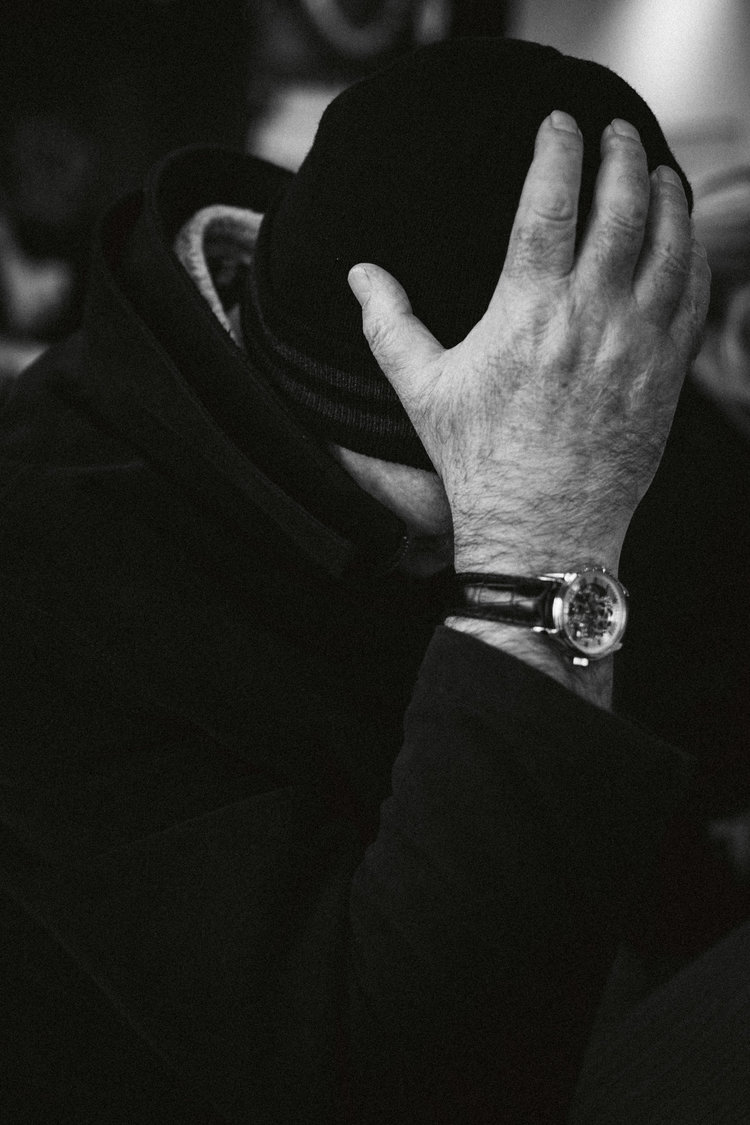
I reached out to Lucy after stumbling across her work when exploring dementia and photography online and was gripped by her imagery. In the past I have made work concerning my grandmother and the effect her dementia had on herself and the rest of my family. I appreciate Lucy’s work as she illustrates the ability to create her own documentary series, which are deeply personal, as well as balancing a more commercial work load, perhaps a career path that I could venture into in the future.
B: It would be wonderful to see your project in a gallery space or magazine as I feel its so important to illustrate dementia in as many ways as possible, and to raise awareness for those suffering and their families. Here are a few questions, please only answer whatever you feel comfortable with, I tried to phrase them well but apologies if not.
L: I’d love to exhibit the project. Already it was exhibited by Monmouthshire Council (Wales) as part of their consultation process with family and carers. I’d like to exhibit UK wide and I’m trying to make contacts in Dementia agencies etc.
B: Have you used your family as subjects in your personal work before?
L: No. I always wanted to but felt weird about it. I guess I didn’t feel like we, as a family, did anything different or unusual to photograph (other than your typical family photos).
B: It’s hugely courageous for your family and yourself to create this body of work, especially with the deeply difficult subject matter, what made you want to raise awareness for dementia? Do you think there’s more that can be done to help people learn about it?
L: It took 2 years for Dad to get a proper diagnosis. Those two years were really difficult because I think everyone knew something was wrong and none of the medicine or procedures they put in place were helping.
When he got a dementia diagnosis we all immediately thought of Alzheimer’s and forgetfulness and we had to learn very quickly about the form of dementia Dad had. It’s not the same at all. Nobody knew much about it, including doctors. We had to research everything and find support for ourselves – which was challenging whilst dealing with a terminal illness diagnosis and whilst dealing with Dad being so very, very sad and frustrated.
I really wanted to raise awareness to let others know about different forms of the disease, and to help others to know that support is out there and, though it’s a really horrible disease, it’s possible to create some quality of life for as long as possible with the right care.
I definitely think more needs to be done to raise awareness. Happily, even in the short time since Dad was diagnosed, I can see agencies doing great things to raise awareness. My local hospital has a Dementia Friends scheme and is promoting good communication between hospital staff and people with Dementia, which is amazing.
B: When creating the series, would you look at the images after capturing or did you begin to arrange and select them after your fathers passing?
L: Instagram was very fundamental in how I shared. I live in London and Dad lives in Wales so I’d go back as often as I could. When I’d taken some photos I’d share one or two on the journey home when my feelings were very raw.
When it came to arranging them I already had a timeline. Since Dad has died I’ve added a few more in and tweaked some of the writing but the work still follows a fairly linear timeline, diagnosis to death.
B: When looking through the project i felt a bittersweet sadness, as you managed to capture the happy moments while your fathers dementia was progressing and I think that’s a really rare thing to achieve, how do these images make you feel and are you pleased with the project looking back?
L: Dad’s illness was absolutely devastating for him and our family. Though we all dealt with our grief in different ways, we all shared the desire to help make Dad’s life as good as it could be whilst he lived with the disease. Every time a new challenge came up, we’d be focused on how to make the best of it for him. Dad had an amazing sense of humour and we always tried to honour that and make him laugh whenever we could.
B: How did you go about capturing the images, were you equipped with your camera each day with your father?
L: I almost always had my camera with me, though I didn’t always take photos. I use a Canon 5D3 with a 50mm lens. It’s a big camera but Dad (and my family) were used to me having it on me all the time.
Whilst Dad lived at home I’d take photos almost every time I visited, it was a bit harder once he moved into the care home as he was chair-bound and couldn’t move, and there were other residents around who I didn’t have permission to photograph.
When I photographed I was really sensitive. I never ever wanted to make Dad feel self conscious, or to be unethical/ inappropriate in the way I worked. I’d often show Dad the photos I took and talked to him about why I was taking them. I never over shot and would take a shot here and there, never too many at a time.
As well as being a photographer I was also his daughter and sometimes I just needed to be there with him rather than looking at it all through a lens.
B: How did your father feel about the project? I understand from personal experience that photo taking was something my granny found silly and fun, and enjoyed but with mood changes there was sometimes a fear or confusion, I wondered if this was the same for you? His agreement to the project is wonderful in itself and illustrates a huge selflessness.
L: I don’t know if Dad thought of it as a project. When he was first diagnosed I said to him that I’d like to take photos to show other people and raise awareness. He was so incredibly sad all of the time and he said he’d like to raise awareness too. He was always very selfless and always wanted to support others. Because I took photos as we went along, we didn’t much do photo sessions but there were times when I set up some portraits and we were trying to get dad to smile but he couldn’t control his face movements – those photos made him laugh!
B: Which image means the most to you?
L: There’s a close up photo of mum caressing/ holding dad. That’s my favourite because throughout it all, seeing their love for each other whilst dealing with something as devastating as dementia was so moving.
It was taken on the day it was decided that Dad should move into a care home. A very difficult day indeed.
That portrait has been exhibited as part of the ‘Portrait Salon’ 2018 and also made the shortlist for ‘Portrait of Humanity 2019’.
B: Again, the series is so beautiful and such an accurate documentation of dementia, something I haven’t been able to find before. Thank you again for sharing it with the world and allowing an insight into a deeply moving time in your life.
L: Thank you Bryony. It means a lot that you’ve seen it and that it’s touched you.
 Bryony's Blog