The layout of a creative CV feels very different to the traditional CV, with regards to a personal statement and education and grades. I am going to look at features of these four creatives CV’s in comparison to my CV I use to apply for part time jobs.
Nigel Shafran: http://nigelshafran.com/cv/
- He begins with a short line with his birthday and then his location so people know where to contact him and where he is based.
- Shafran’s CV is comprised of several small lists, written in chronological order and categorising ‘Solo Exhibitions’, ‘Group Exhibitions’, ‘Awards and commissions’, ‘Publications’ and books he’s has been featured in. They are all dated, with the name and then destination or publisher.
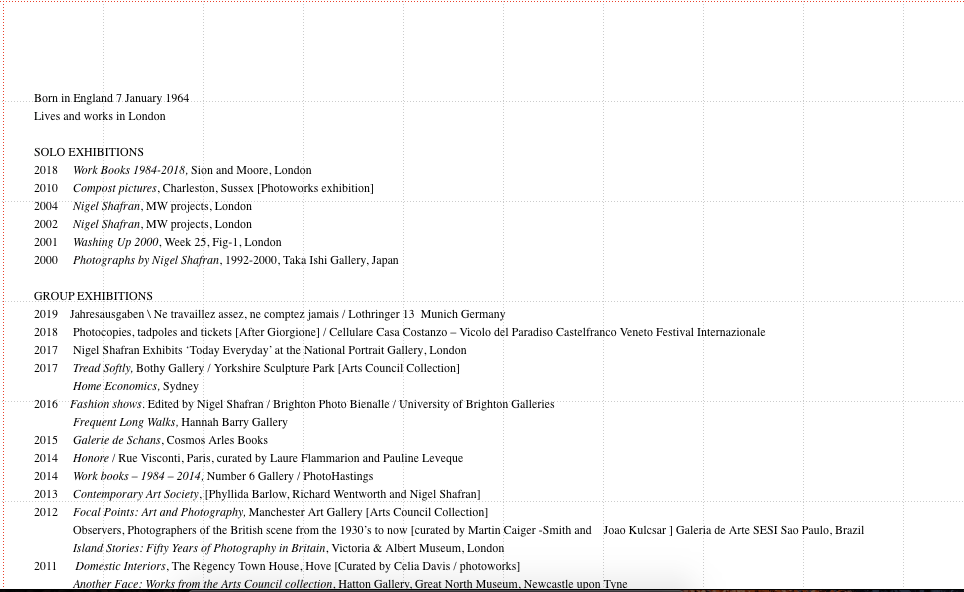
Unlike a traditional CV, it seems to be less concerned with education and grading, and more so with experience and places you have exhibited. There is also no personal statement, so the sheer amount of experience in galleries and displaying is meant to make up for this. I quite enjoy the lack of statement as on a website this would probably belong on the about page as oppose to the CV.
Finn Davies: https://uploads-ssl.webflow.com/5b64384f0a480a43b13d7d9a/5e504b4153428f83cbfa7641_Finn%20Davies%202020%20CV.pdf
- Unlike Shafran’s, Davies was a separate document then placed onto his website, which is perhaps more useful for printing and sending to clients.
- Categorised into ‘Info, ‘Education’, ‘Work’ and Skills’
- Begins with birthdate, I am not sure if this is entirely necessary as it could lead people to be bias but many seem to add it.
- There is then a brief statement on his practice, explaining his work as a designer and his other interests. Summarises what he can do in a clear and concise way, far shorter than a traditional CV.
- There is also contact info which I have on a non creative CV eg email and number.
- He has listed his skills and his number of years experience, which I hadn’t previously seen. Very useful for potential clients as they have an idea of the work you would be capable of completing.
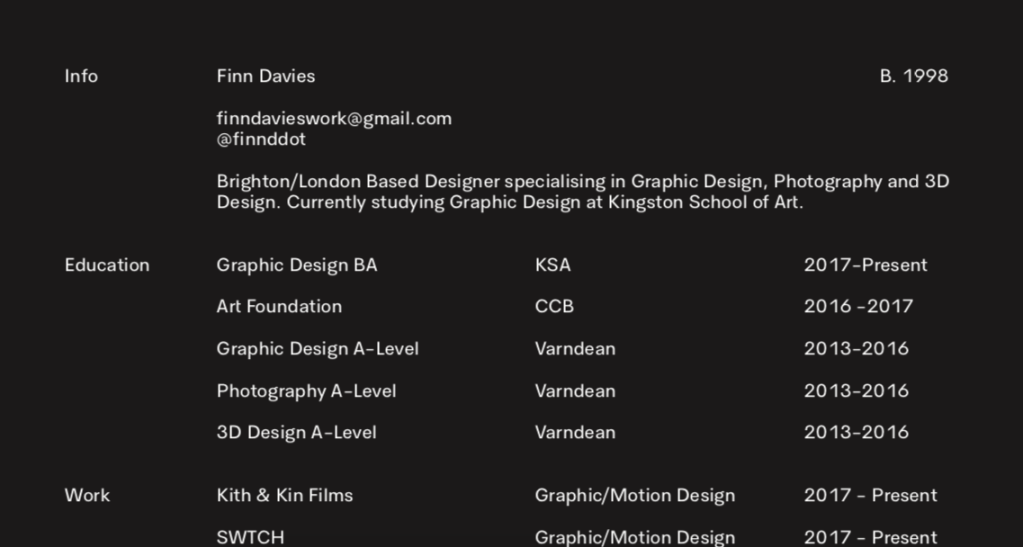
In comparison to my traditional CV it feels similar in its layout with education and contact details listed. However the inclusion of skills was a new addition that i can see being important in a creative CV.
Alec Soth: https://alecsoth.com/photography/about#biography
- Main page is a biography, with a statement illustrating his main shows and books that have been published, a mini summary of the whole CV it seems. This seems useful.
- Unlike the other CV’s, Soth’s requires several different pages, he has chosen to do it as weblinks instead of a list.
- The categories seem to be the same for photographers, organised by shows, press and publication. This is not something done on a traditional CV, there would simply be experience, not listed where work had been displayed.
- It’s easy to navigate and is organised, doesn’t feel like a CV in a sense as it’s not a list.
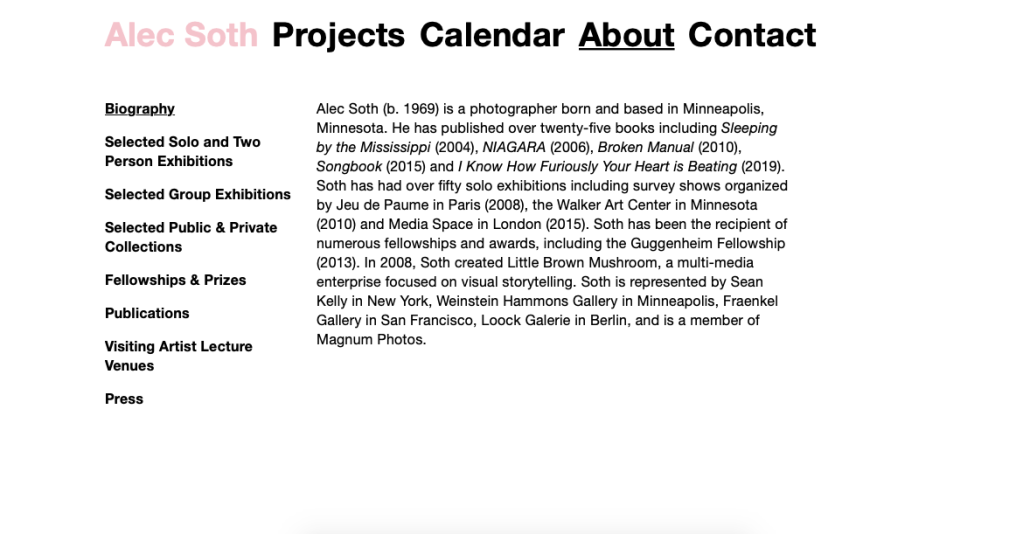
Soth provides us with a summary of the CV, which is very different to a personal statement that people tend to write at the top of their traditional cv’s. There is also no mention of education or grading, which seems to be quite a big part of the other CVs.
Simon Norfolk: https://www.simonnorfolk.com/cv
- Similarly to Soth, Norfolk has different links to bring you down the page to each category. He has chronological lists of his exhibitions as well as commissions and prizes. Easy to navigate and lots of information and experience. It appears the more there is on the list, the more impressive it looks with these CV’s.
- He has listed his birthday and where is he is based, which I would usually do on my normal CV, I would just leave contact information.
- He starts with a statement which summarises his practice and interests and then goes on to summarise his biggest shows and awards.
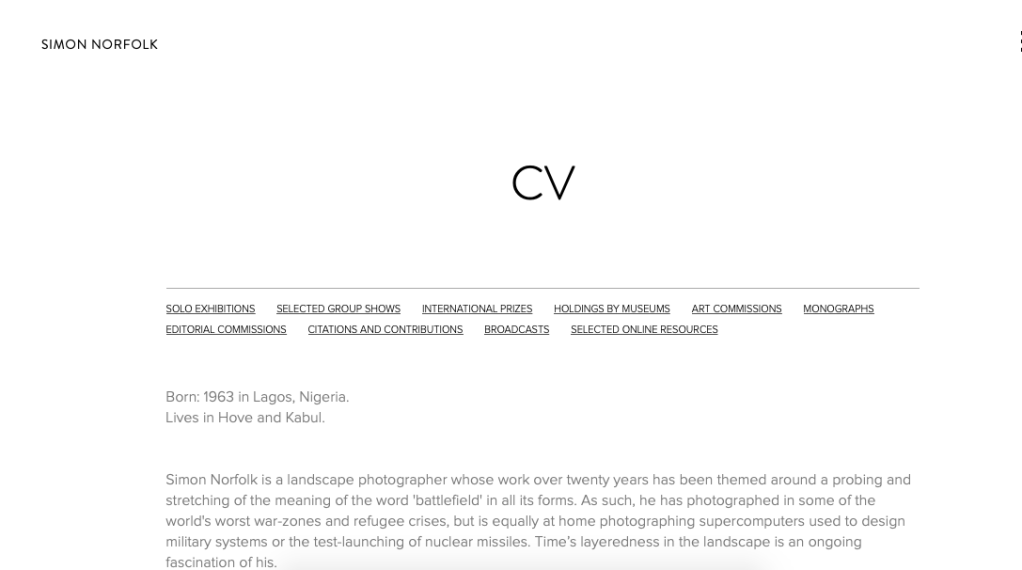
This seemed more personal and the statement was a similar length to how it may be on a traditional CV. However there wasn’t evidence of education or grades, and the experience was the work he had made, not his time working for others.
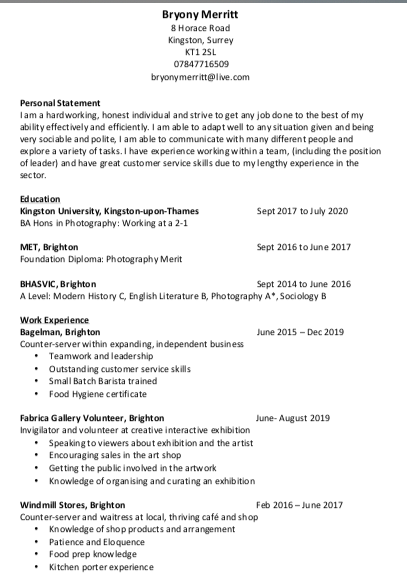
This is my CV above which I use to apply for part time jobs not necessarily concerned with the creative industry. Like the others it has a small statement but its quite general and doesn’t apply to any jobs specifically. The statement in a creative CV feels more like an opportunity to express your practice and for someone to give you because of it, not due to punctuality and more general skills.
There is also a big focus on education and grades, which was absent from all the other CV’s I looked at. They were far more focused on shows and books that had featured their work and skills. There doesn’t seem to be a need for explaining the roles that were underdone in each job role, simply a name, date and location.
 Bryony's Blog