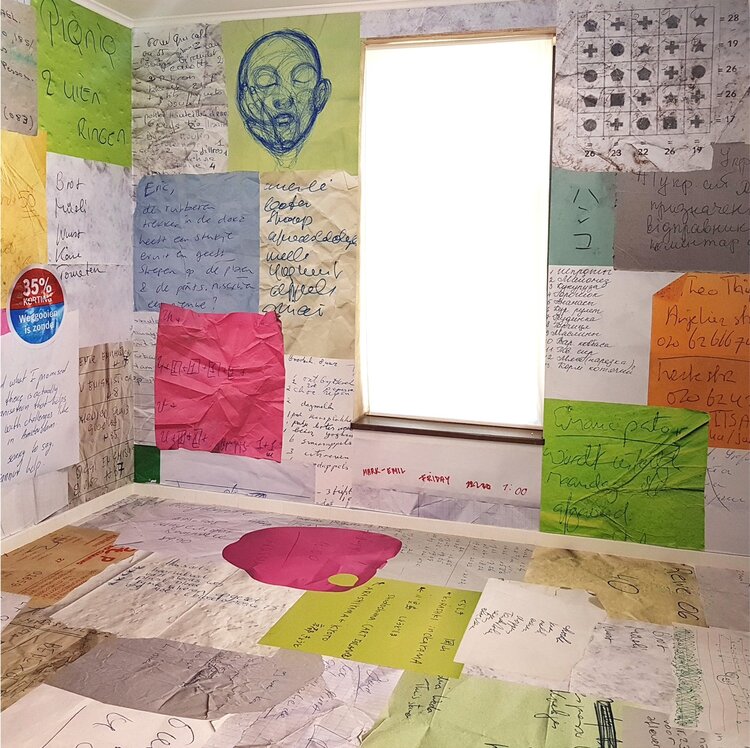
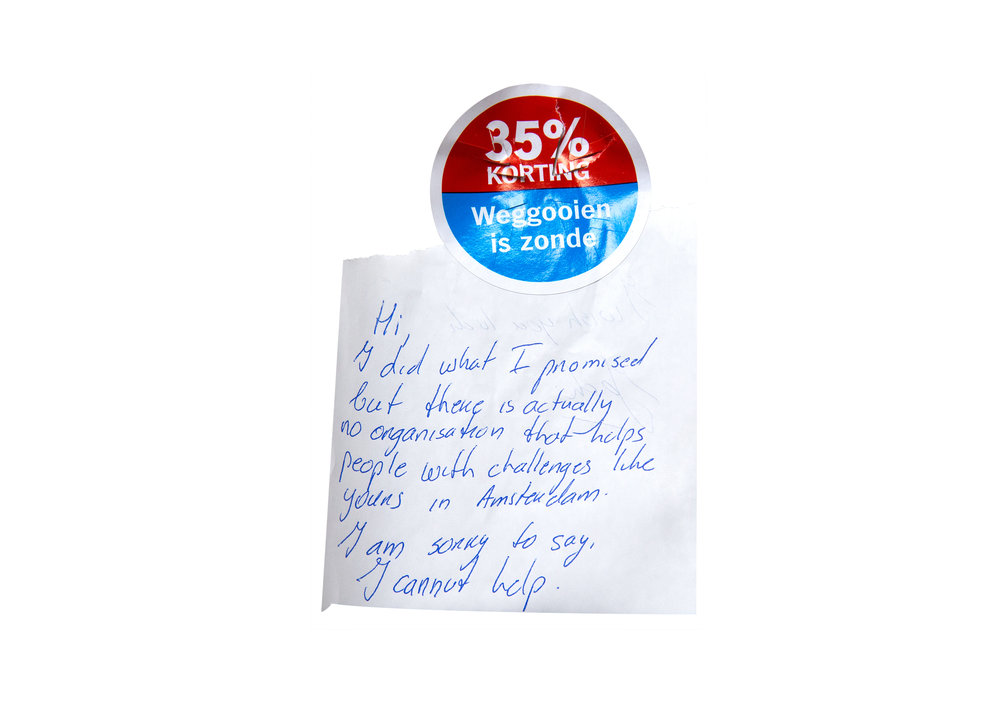
I found Snizhko’s work whilst recently researching into mixed media art pieces online. She is a Ukranian artists working with sound and visuals to create pieces that are atmospheric and indulging for the viewer. ‘I need your help. Florina‘ is made up of 100 small paper notes found on the streets across different countries, all written in different languages . Snizhko views these items as artefacts with inherited personalities, that like most writing and art, can be interpreted differently by everyone. Inspired by theories on matter, these written notes are then converted into musical notes to “build a dialogue between visual and verbal elements”.
The idea of combining art and science, as well as music is something that I applaud. I believe art to be a spectrum that any other practise can fall into or cooperate with and this is a perfect example. The use of mixed media brings into play the question of authorship, does Snizhko have the right to display these images? Are they now hers because they are found? Its good to make people question and think, to not simply take art at face value.
In my work I would like to include mixed media and found pieces, as I have previously. There’s something about the way an item appears when scanned that adds value and makes it appear differently, theres an archival value added that wasn’t previously there. The use of space is inspiring, as the viewer feels immersed and encapsulated in the imagery and sound, and installation and presentation is something I am always considering in the back of my mind, thinking about how it should be presented.
Finally, it’s the involvement of the public that stands out for me in this work, the unison of many different people from different places communicating without knowing they are. Collaboration is a key part of the dcoumentary process and this is just one of the ways it can be explored.
Eng is a Canadian photographer known for her exploration of identity, specifically in her recent project ‘China Dream‘ which looks at the fractured identity of second generation Chinese citizens. Her work also has a key focus on the ‘rapid cycle’ of destruction and construction in modern China.
The series alludes to her struggle with her heritage and peoples reaction towards her as she travelled, due to her looking Chinese but not speaking the language, many approached her and attempted conversation. She described this as a reverse culture shock. The project spans 5 years of exploration and travel into her origins, resulting in a series of atmospheric and abstracted imagery, looking at objects, people and building but through the same alienated gaze.
For me the series reflects her identity but in such a subtle way at first glance. It’s only when we look closer and take in the context of the imagery that we understand her abstracted identity. In the images she also plays with the idea of orientalism being kitsch, with tradition being passed down over generations and altered each time, reaching the Western world and symbolising something very different. I marvel in her twisting of stereotypes and presenting viewers with what they already know as ‘China’ when in fact theres a far deeper focus on how this has been manipulated.
Eng also appears to play with Asian technique and aesthetic, all the images holding a faded, misty hue, giving them an aged and precious appearance. The image below reminds me of ancient scrolls and scriptures, the orange and yellows again adding an aged look.
My favourite image from the series depicts fish swimming quickly, yet frozen by the cameras gave. It works as a perfect microcosm for China, the scales and colours alluding to a sense of glamour and riches, China known for its dynasties of the past and its rich industry today. However, this is counteracted by the movement, the sense of no rest and a lack of time, referring to the constant construction and deconstruction going on around the country.
I have selected Eng’s project to mention as I find it different to many other documentary projects. Theres a real sense of thought into the colours and techniques that allude to China’s past and present that I find vital to the images in order the convey Eng’s confused identity. I also enjoy the documentation of many different items, places and spaces, as in life it cannot simply be one person, or one place that has shaped a person, but a combination of many and to include these is highly important in order to present the whole picture.
I am very appreciative and glad for my time at Fabrica this summer as I feel it’s added a valuable insight to how galleries work and allowed me to engage with the public on a more intimate level. I love the exhibition I was volunteering at as it was purely interactive, something I was initially disappointed by but rejoice in looking back. It introduced me to a number of different and diverse people, public and other volunteers and illustrated the welcoming space that the art world can be with the right people. Many of the other volunteers had no background in art but simply liked to be involved and interacting with others. Fabrica as a space has an integral interest in inclusivity and this is reflected in everything they do, from the space itself to the workshops they run, and this makes me proud to have been a part of their gallery this summer.
Looking back, I enjoyed all three resident artists but Sara Dare’s work was the most enjoyable to watch the public be a part of due to the amount of freedom and the joy the most unexpected people found in picking up a paintbrush or pen. I was also inspired by the questions she asked, who owns art, who decides what art goes where and what becomes big?. In the digital age these questions are so important with the amount of people now able to take photographs and create their own pieces, that the people who decide ‘high art’ need to change and be reviewed in this new era.
Whilst the documentary practice may not directly feed into this style of work, asking questions and having conversations is a way to progress with a project and I feel my time has helped me meet some wonderful and interesting people that I wouldn’t have otherwise engaged with. These ar people whom I could potentially work with in the future, perhaps looking at their lives and the work that they do.
I have thoroughly enjoyed my time at Fabrica and would definitely volunteer again when I’m next down. I’m intrigued to see what they have to offer in the next art term.
‘This exhibition brings together over 40 works of art made between 1990 and today by Danish-Icelandic artist Olafur Eliasson. Born in 1967, Eliasson has created a broad body of work that includes immersive installations, sculptures, photography and paintings. The materials he uses range from moss, glacial melt-water and fog, to light and reflective metals. Eliasson’s art comes from three particularly important interests. These are: his concern with nature, honed through his time spent in Iceland; his research into geometry ; and his ongoing investigations into how we perceive, feel about and shape the world around us.’
I found out about this exhibition through the Tate’s instagram page and the many images users were posting in response of their time visiting. Eliasson puts experience at the forefront of his work, thus making it clear why the exhibition is so vital and perfect for this digital age. There are plenty of opportunities to take selfies and images of oneself as the whole space is aesthetically pleasing. This love of the public being involved is why I wanted to visit as I’m interested in how art can be more welcoming when interactive, and to a more diverse audience.
Eliasson describes the layout and objects in the the exhibition essential for creating a ‘temporary community’, as people step more carefully and are aware of those around them. This again adds inclusivity and helps remove the idea of hierarchy and pretentiousness that surrounds art, linking back to my volunteering with Sara Dare questioning who gets to choose what art goes where and why?
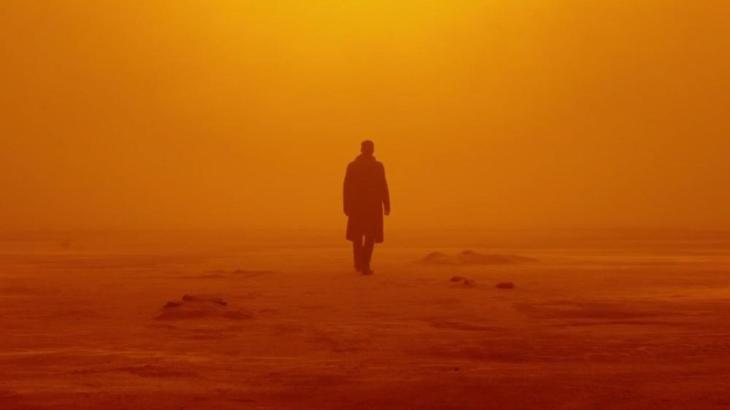
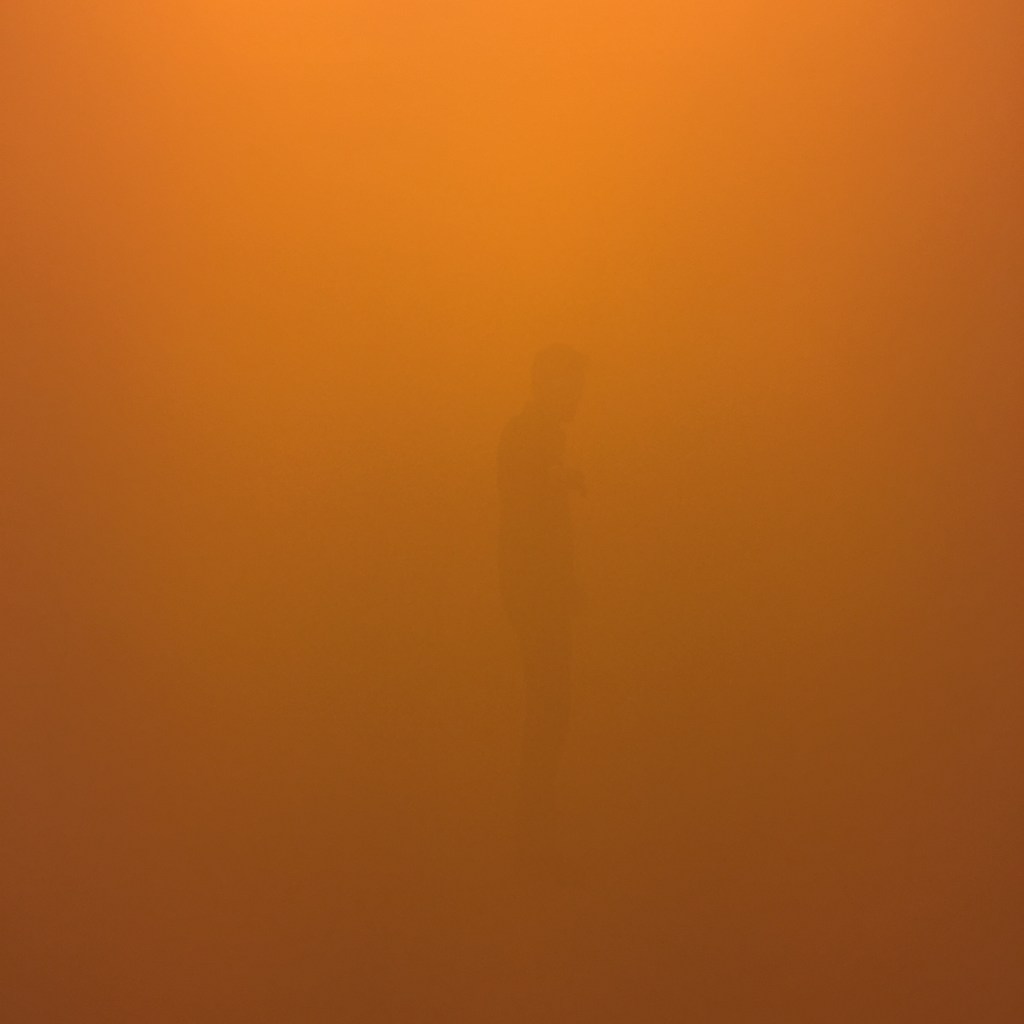
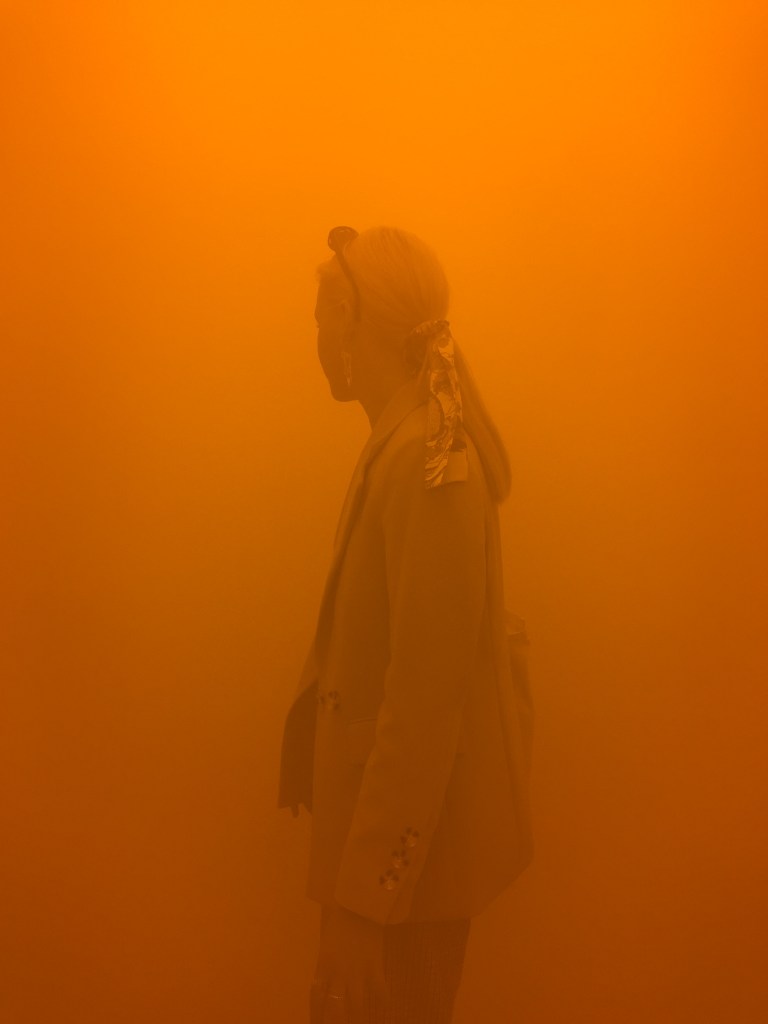
My favourite part of the exhibition was an installation named ‘Die Blind Passenger’ (2010) consisting of a long corridor, created inside a black box that uses light and fog to restrict and distort viewers perception. Inside it felt like Roger Deakin’s recent cinematography for Bladerunner 2049 (2017), orange and yellow dusty desert hues. The allude to pop culture adding to the hype around the exhibition, although the film was made eight years after the piece.
Bladerunner 2049 (2017)
Inside the piece you are unable to see a metre and a half ahead of yourself or behind so your fellow gallery goers begin to disappear. Theres a sense of the unknown and a blindness, almost as though your eyes are closed as you tread more carefully and feel along the walls. I felt an escapism perhaps only attainable through art and something I hadn’t felt before.
I would highly recommend a visit, even if simply to watch the social aspect and become a part of the ‘temporary community’. I definitely have an interest in the ownership of art and inclusivity so this is something that this exhibition has helped me to explore and will hopefully become a further part of my degree. I also found the inclusion and transformation of a space to be highly important in my practise, even if its not so obvious at first. The recognition and feelings we associate with certain spaces, perhaps the home or places we visited as children continually stay with us throughout our lives. Although Eliasson isn’t depicting this specific feeling of home, it makes me see the importance of creating installations and spaces, and that documentary photography doesn’t have a box its confined to, I could look at including a more fine art stance in my practice.
This week I was volunteering in the final residency of the show, led by Annis Joslin. Her work is described on her website as “seeking to explore lived experience through a reflective, participatory process encouraging dialogue and freedom to play. She uses different approaches to generate material, including drawing, animation, photography, performance and story-telling to create lens-based digital artworks that can operate on different platforms, such as galleries, museums, online and in community contexts and situations. “
The exhibition focused on trying to get everyone engaged and also our interaction with objects and what this can mean. This linked back to Jo’s exploration of the subconscious and meant people had to think about what they were doing when placing things and why.
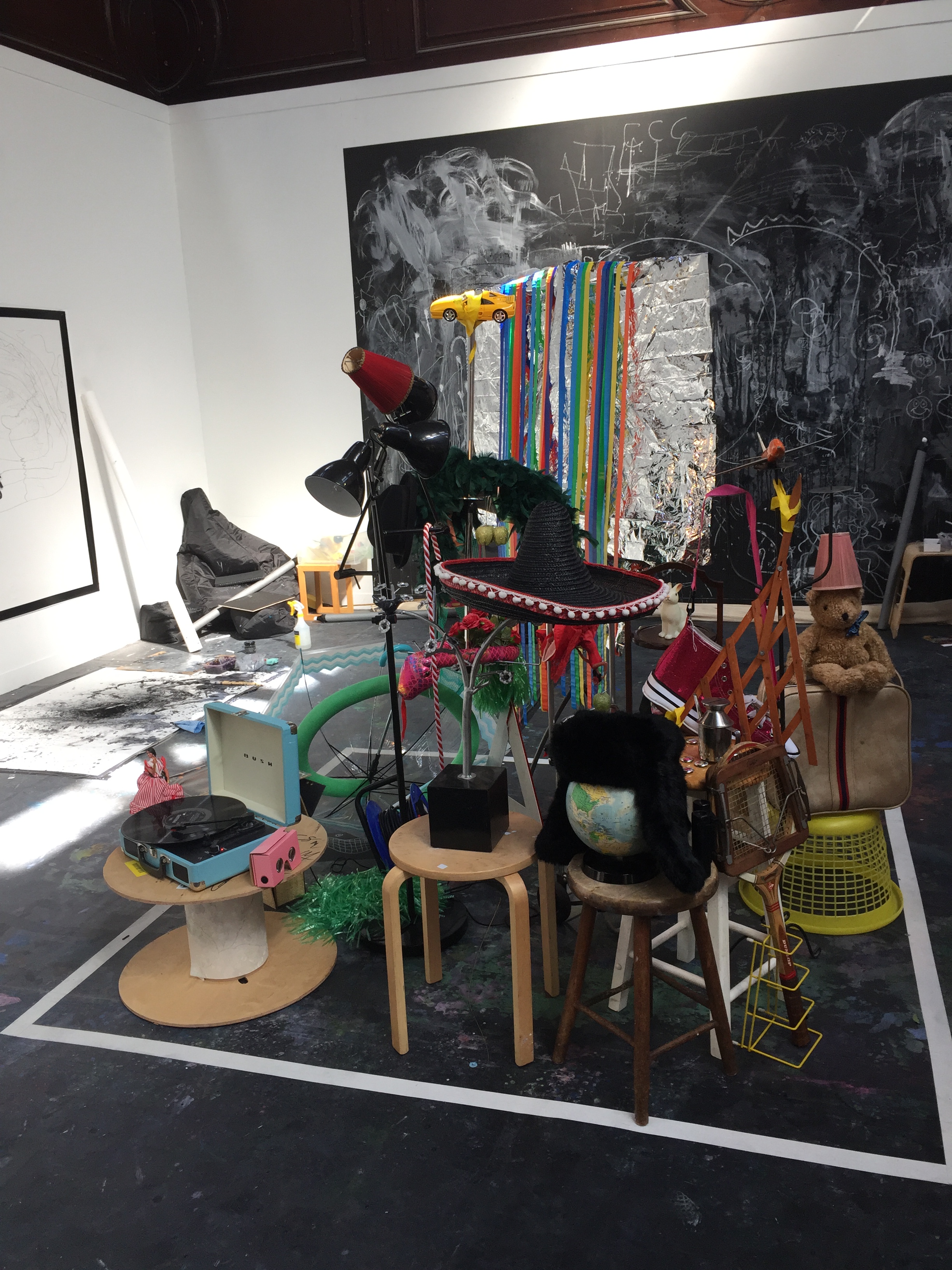
There were several activities for the public to engage with and I was mainly situated around one that required people to interact with a set up collection of random objects within a marked out square. The objects had been taken from Annis’ house as well as bought from charity shops and found items. The public were invited to select one of four folded pieces of paper in a hat, each with an instruction concerning the scene in front of them. For example, one said ‘Replace an object’, leaving an individual to remove one and select a new object from a table with many more. One man said he had real trouble choosing an object and felt bad moving other peoples who had previously taken part. It brings us to question who is in control of art and who decides when it’s final and finished.
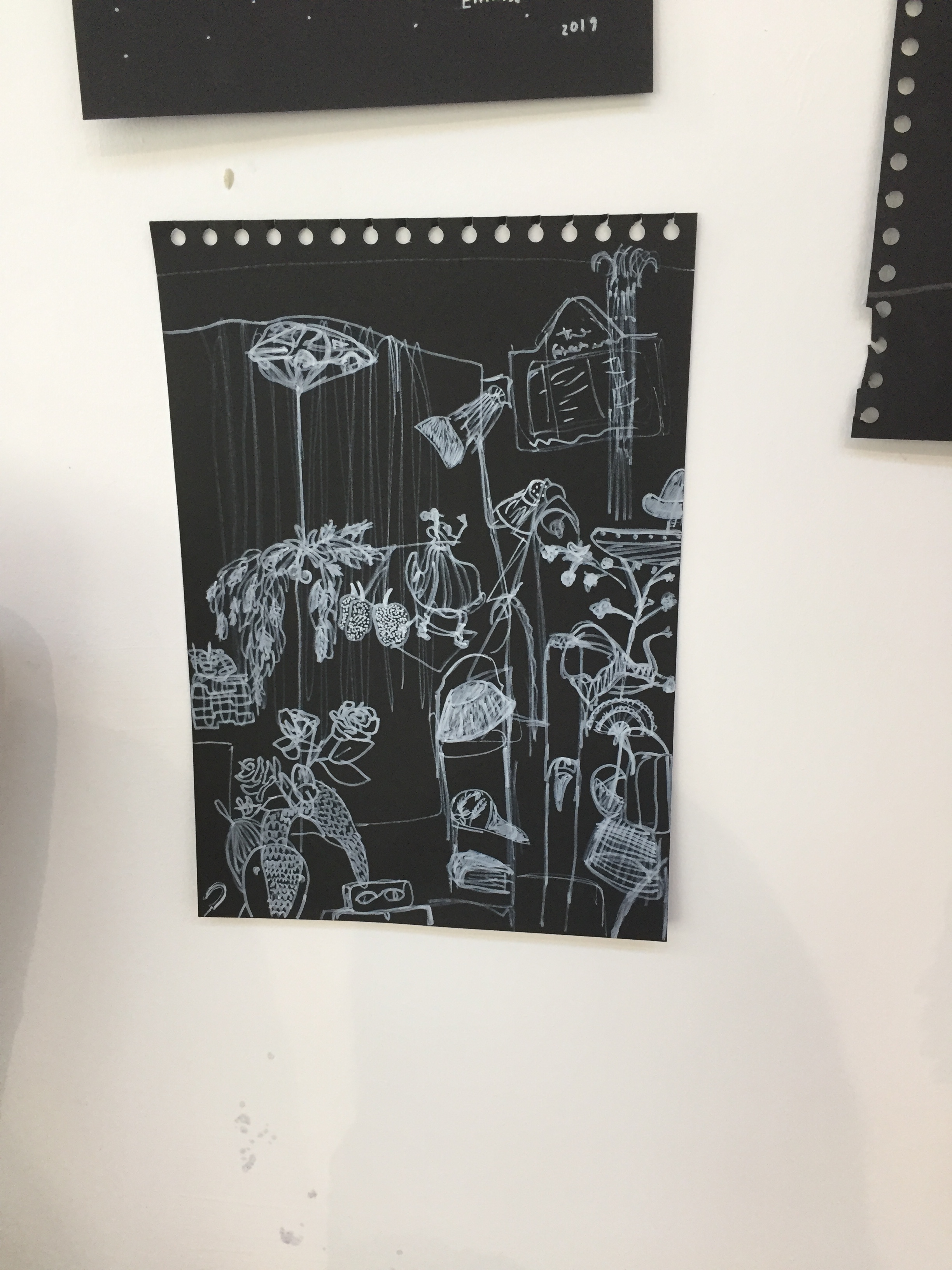
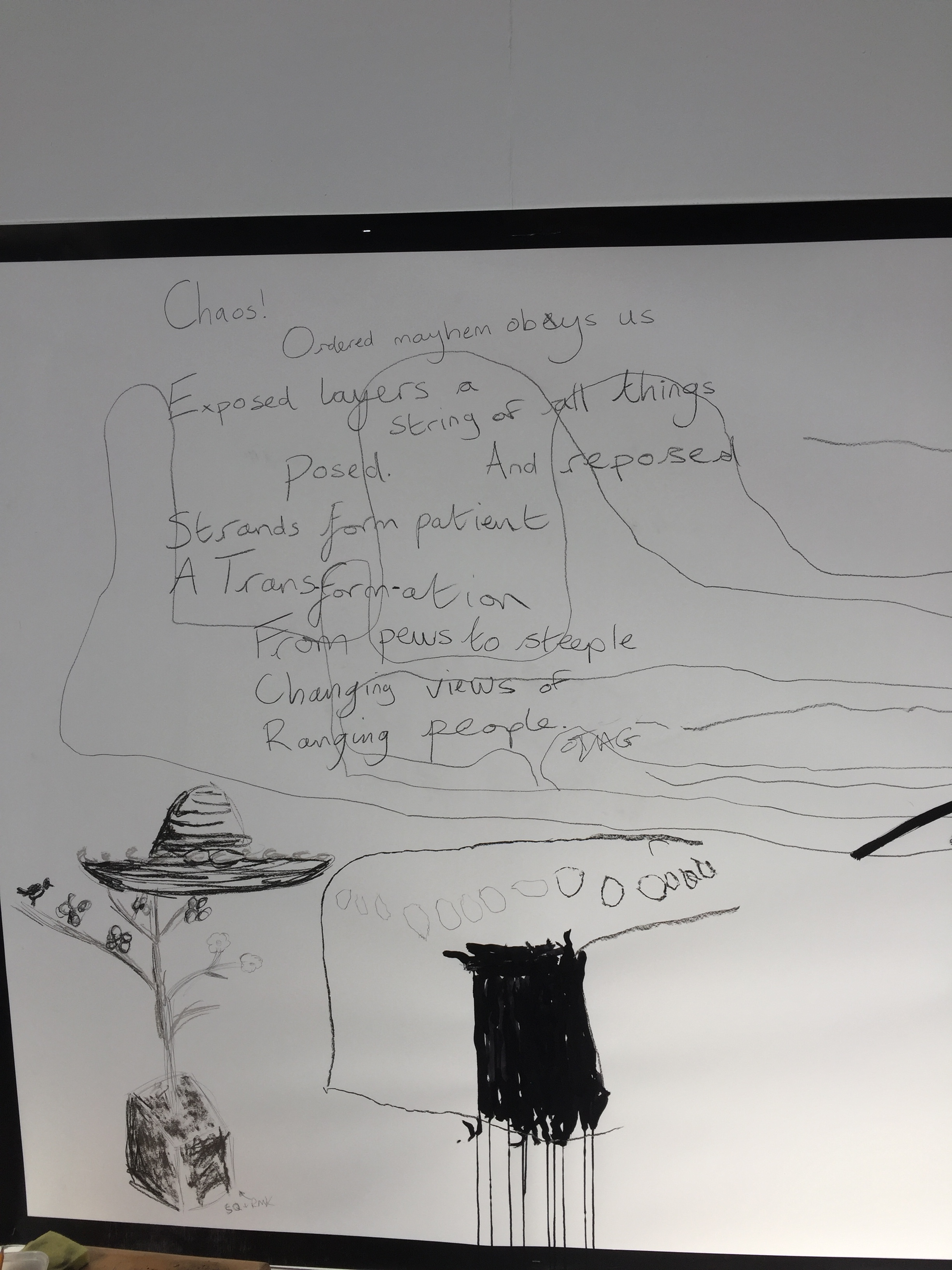
Surrounding the scene were notepads, blackboard style walls and paper to encourage people to draw and respond to what they were seeing. I spent much of the session drawing what I could see, and it ended up being a testament of the moment I began, as items begun to change around and disappear or reappear in different spaces. The freedom of the page encouraged many people to join in, one young man even sitting for half an hour noting, and then writing a poem for the exhibition and his experience.
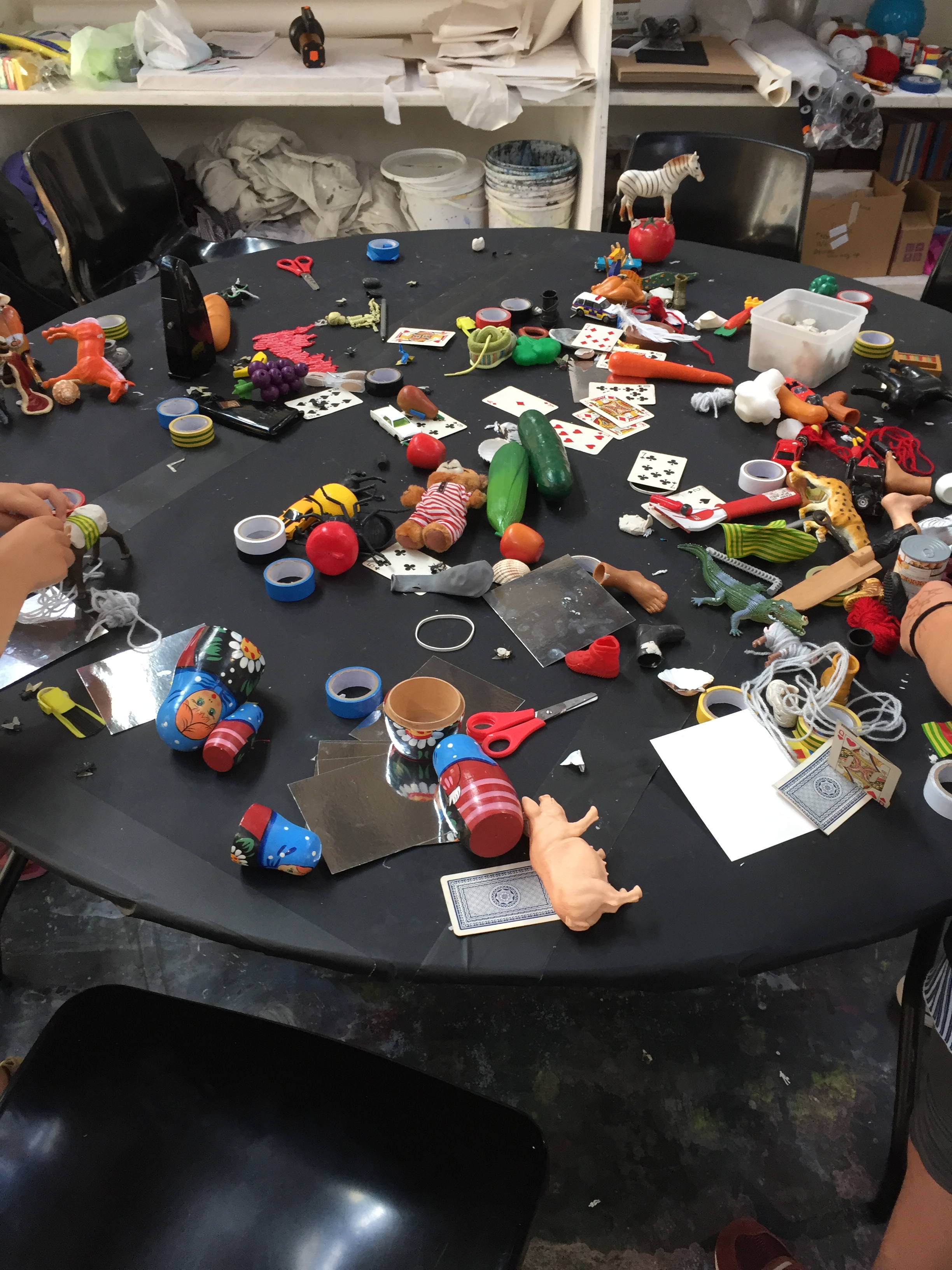
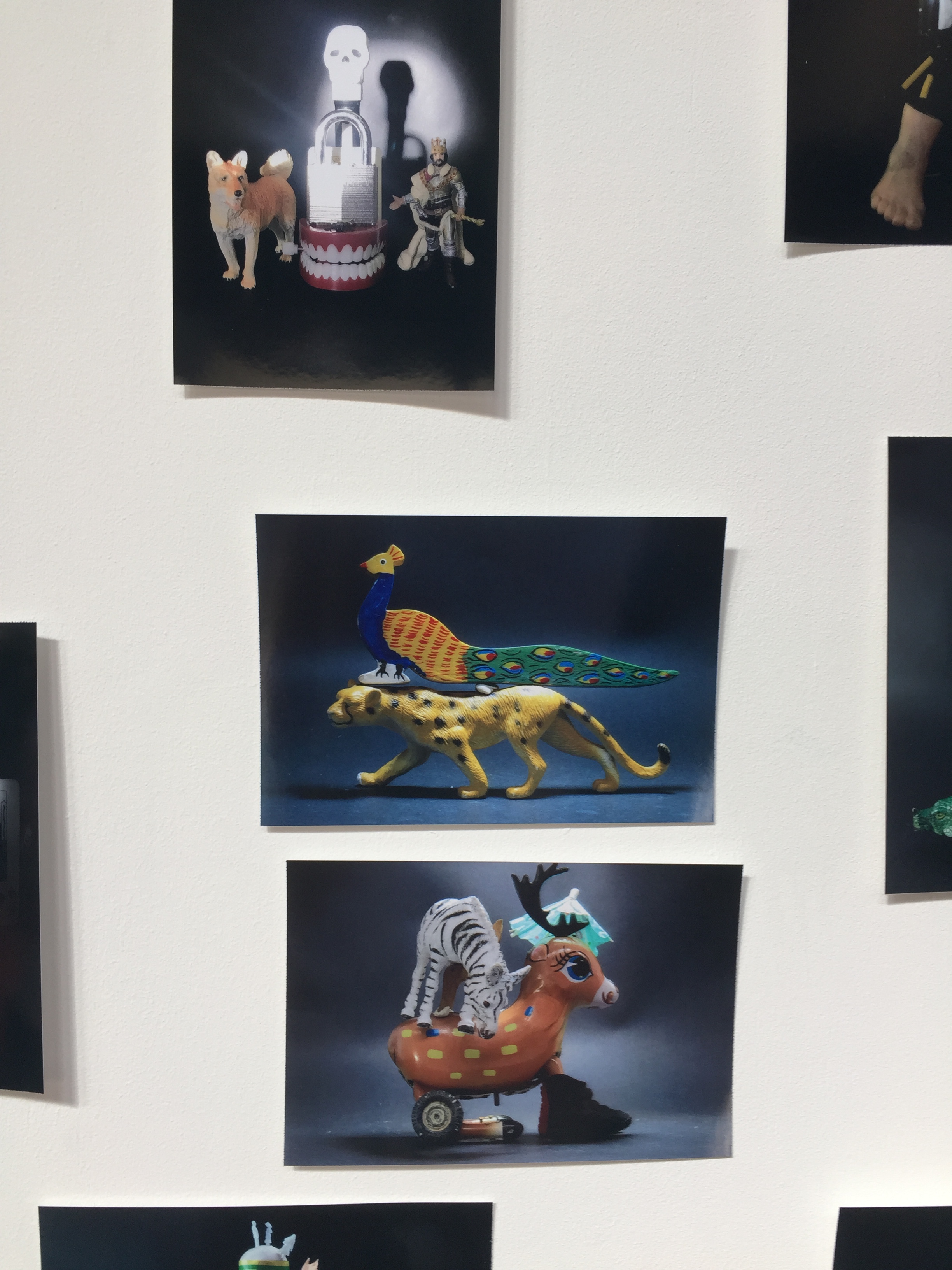
People also had the opportunity to used mix matched toys and smaller objects to create an image in a light box. There was blue tack, tape and plenty of sticking materials to enable people to attach limbs and mini figures together; again illustrating the different ideas we have surrounding objects and how we all react differently. Some of the final images look almost like museum artifacts, photographed in the perfect light.
The exhibition has proved so helpful and intriguing to me, seeing how many different people will engage in art when given the opportunity and why we must make it accessible for all. I have also really enjoyed talking to the public and asking people why they choose certain items, or techniques and could potentially see myself going down this route in the near future.
This week Jo Offer, senior lecturer of inclusive arts at Brighton university was in residency. She is described by the university as being “avisual artist and designer who’s practice and research is concerned with communication, collaboration and engagement and how inclusive arts strategies can connect people from diverse backgrounds.”
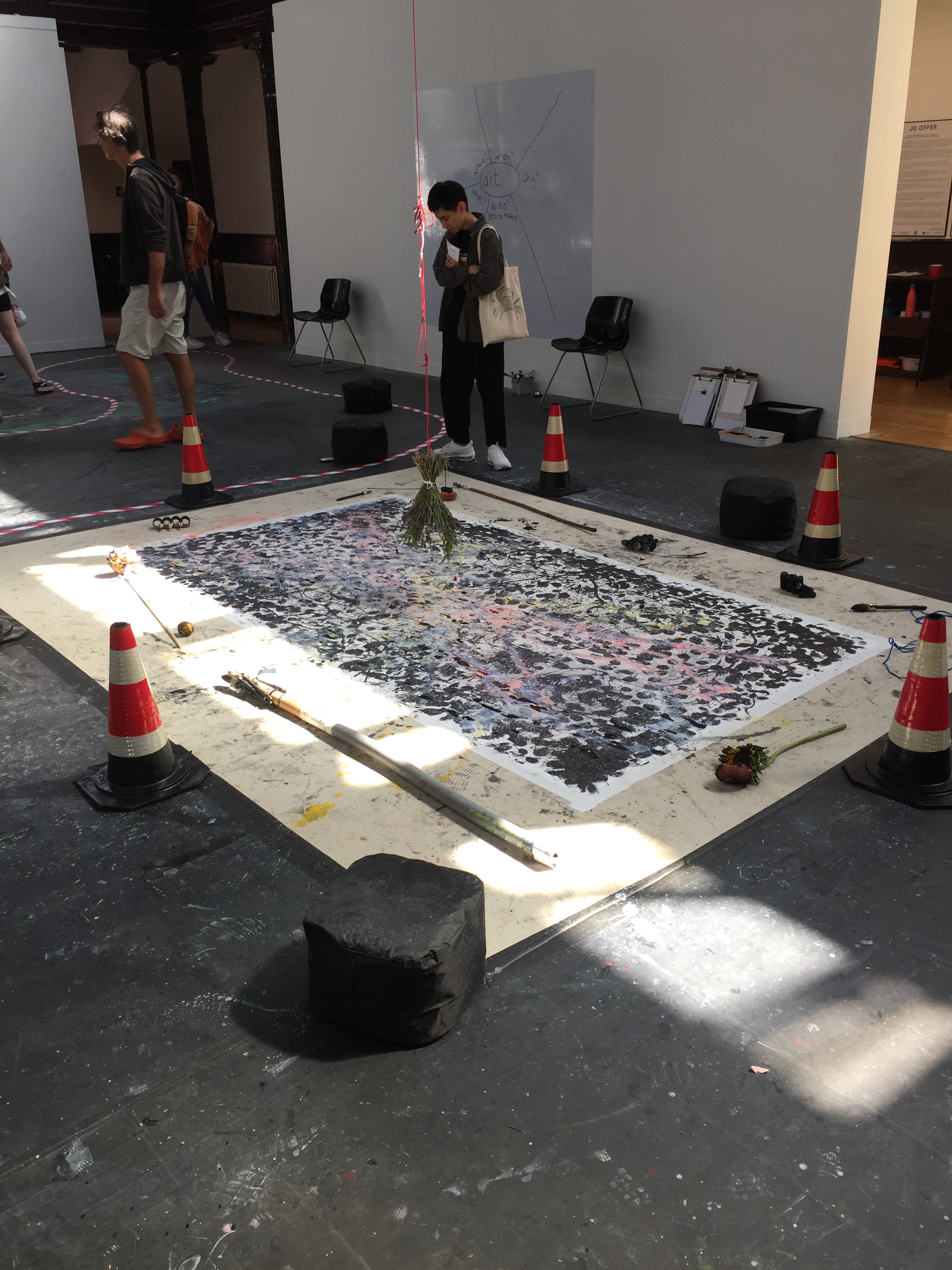
The room differed quite a bit from Sara’s time at Fabrica; on arrival there lay a painted piece created by the pubic on the floor and hanging above, like a pendulum was a dried bunch of lavender and other plants, gently swinging in a mesmeric way. The public were asked to respond to this movement and the painting by using different paper typed on a clipboard and drawing, etching or doing as they please on the paper. I had a go in the session and it felt freeing to let charcoal glide over the newsprint, onto watercolour and black paper.
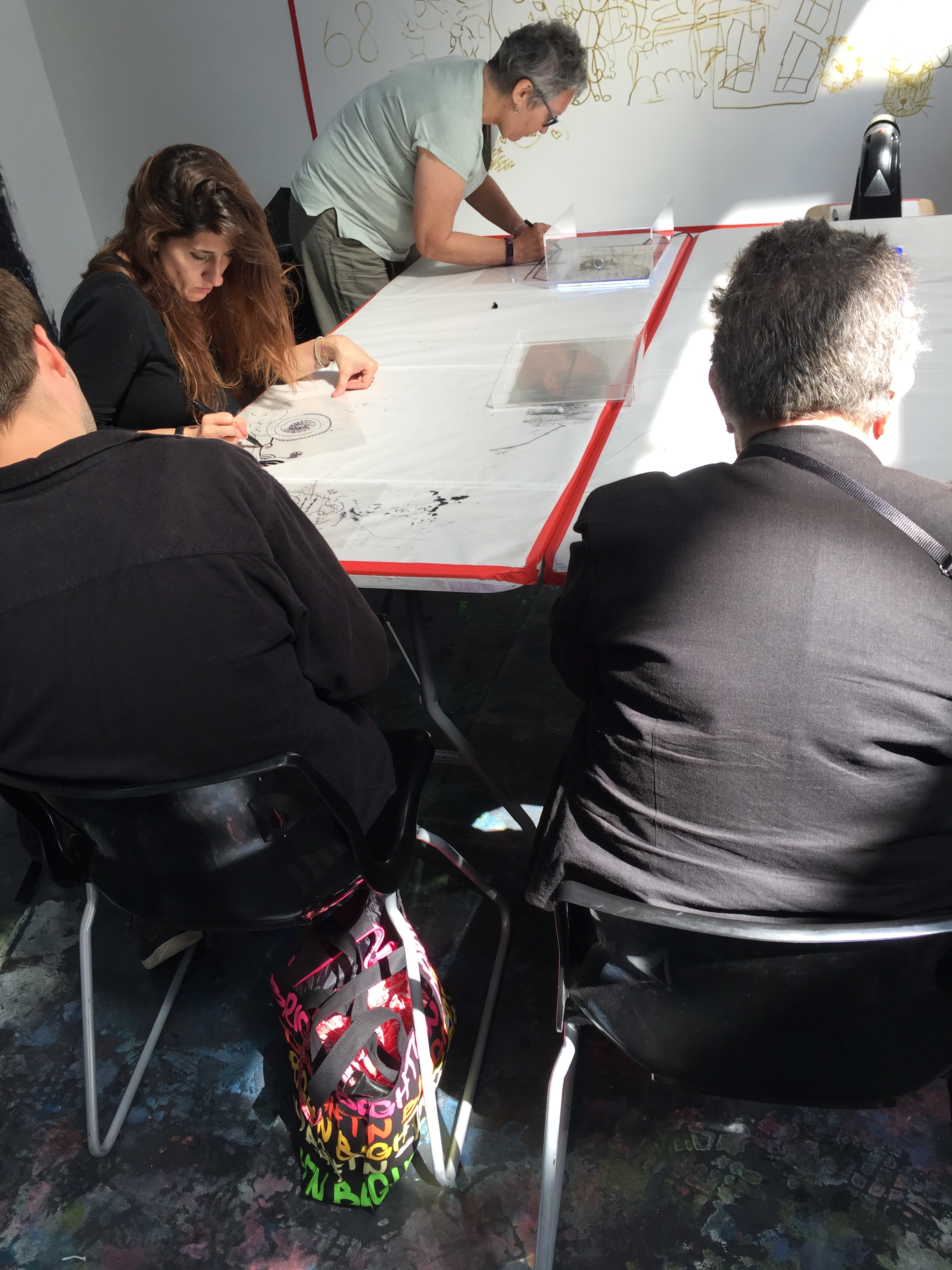
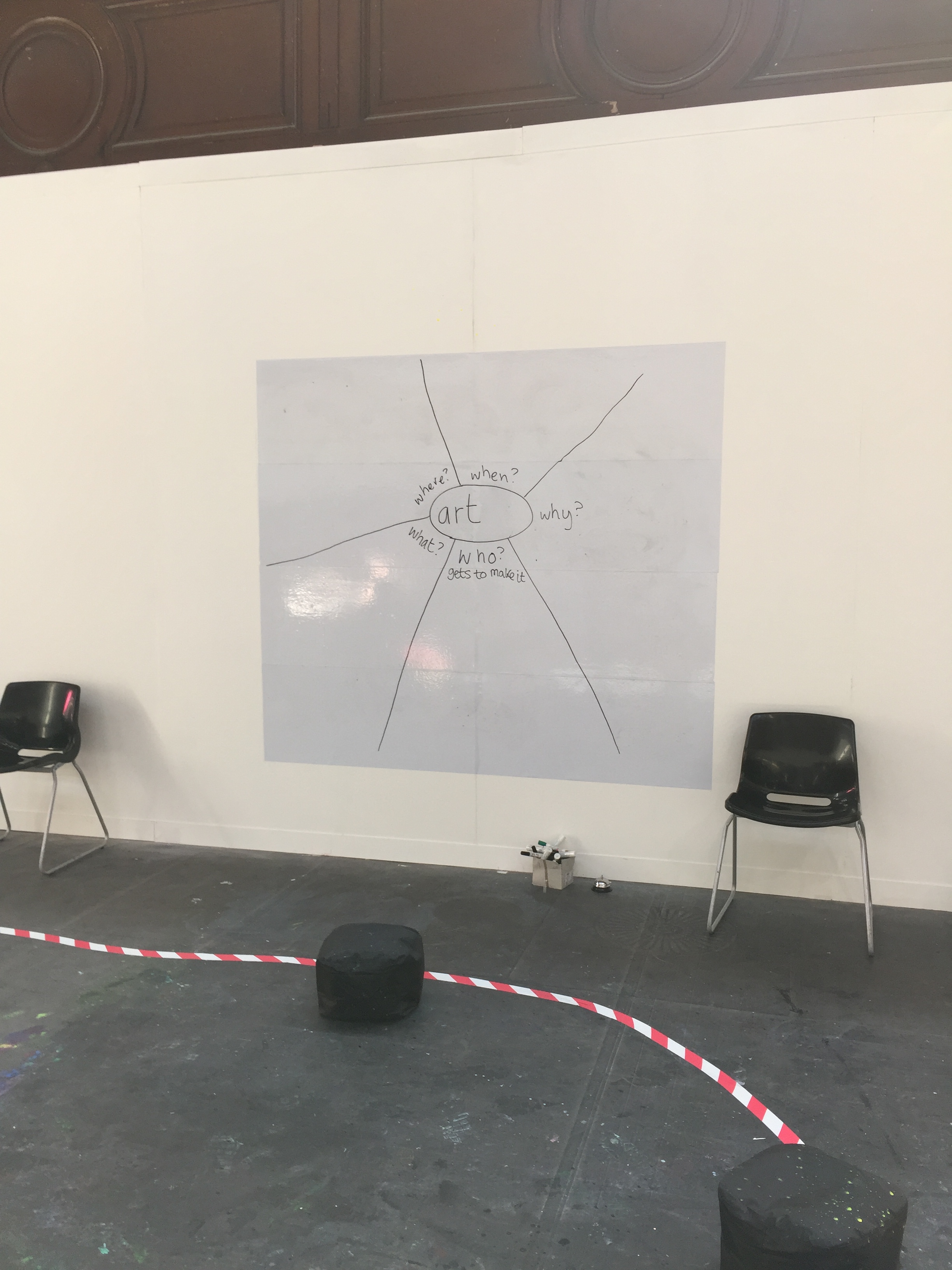
There was also a table set up inviting people to doodle their most common doodle. Jo was interested in the subconscious mind and that when we doodle; we all have something that we repeat, without thinking about. She challenged viewers to dig deep and try and draw out what they thought this was, delving into their subconscious. I found this activity the most popular as it really made people think before drawing, the opposite of what a quick doodle is known to be. I enjoy the approach of trying to understand why we do certain things and bringing a more scientific aspect into art. The nature of the activity highlighted the importance of allowing everyone to participate in art and was continued by her questions written on a whiteboard.
The questions were broad and it was fantastic to see the diverse range of people that answered, illustrating that there were no correct or incorrect responses. Although I don’t have an image of the final board, people were writing things that I had never thought about before or didn’t perhaps agree with, but this all worked towards Jo’s necessity to open up art to all.
I am currently volunteering over summer at Fabrica gallery during their July/August residency. What’s exciting about this exhibition is that its changing every two weeks, bringing in a new artist to takeover, thus allowing myself as a volunteer, and the public, to experience new art very often. the exhibition this year is named ‘Putting Ourselves in the Picture’ and revolves round inclusivity in the art world and trying to get everyone to partake and question who choses which art is deemed a masterpiece.
Exhibition statement from the gallery: “At the heart of this dynamic and highly experimental exhibition is the question ‘who gets to create art and whose work is selected and therefore validated for public view?’ We’re seeking to understand more about how access to creation spaces might shape the supply of art and artists in our society and to demystify the who, how and why of selecting work for public consumption.”
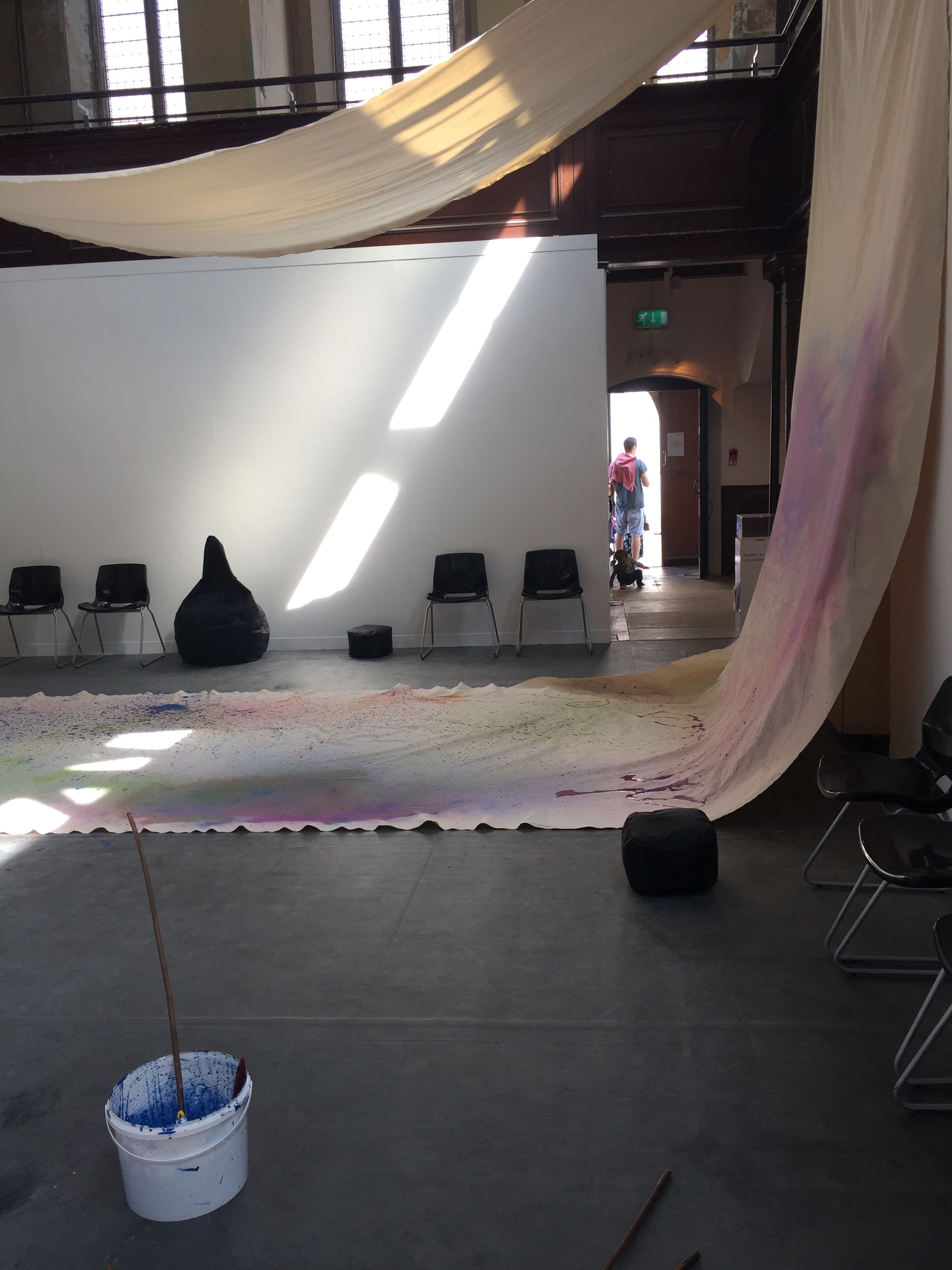
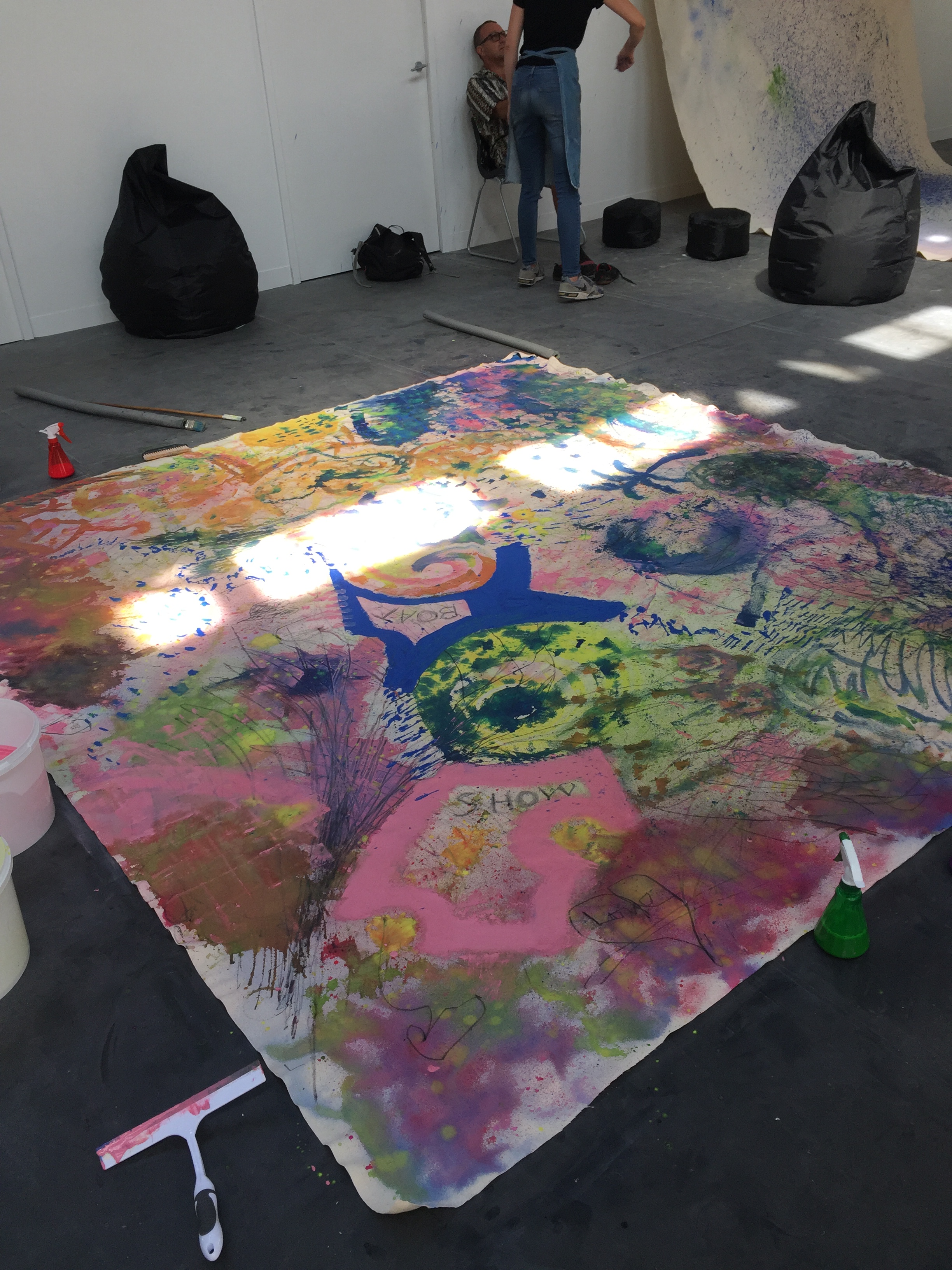
For my first session, artist Sara Dare who explores form and abstraction through painting was taking residency. Her piece had an air of performance, with a huge rotatable canvas enveloping half the space as she encouraged the public to come and use several tools to paint whatever they wished. The public were very engaged and i was surprised to see all age groups attending, from babies to the elderly, all excited by the chance to paint on a blank canvas. As the canvas filled people started to ask questions about painting over others work, about who is deserving of which space etc, all questions which I had never really broached but found so relevant in todays art world. It takes us back to the bigger question of the exhibition, who decides what work is deemed popular and worthy of the gallery platform?
Rotatable canvas from that morningAfter 3 hours on Day 1
I myself had a go with the paint and found it extremely freeing and fun, it felt different to drawing in a notebook or on a small canvas at home, there was no pressure for mistakes, it was simply a free for all. It has encouraged me to try and paint in my own time, even if it simply be a few dashes on a page.
This first session has made me excited for whats to come over the next month or so, and I’m looking forward to seeing the public reaction and what they create in the artistic space as well as what new questions they pose to the artists and themselves.
March 2015 “Dad’s gets a lot of headaches. His sensitivity to noise and light has changed. The world is becoming more and more intense. Too much noise, too much bustle. Light and shadow that makes his world confusing and hard to navigate. It makes his head hurt.” Taken from her website.
I reached out to Lucy after stumbling across her work when exploring dementia and photography online and was gripped by her imagery. In the past I have made work concerning my grandmother and the effect her dementia had on herself and the rest of my family. I appreciate Lucy’s work as she illustrates the ability to create her own documentary series, which are deeply personal, as well as balancing a more commercial work load, perhaps a career path that I could venture into in the future.
B: It would be wonderful to see your project in a gallery space or magazine as I feel its so important to illustrate dementia in as many ways as possible, and to raise awareness for those suffering and their families. Here are a few questions, please only answer whatever you feel comfortable with, I tried to phrase them well but apologies if not.
L: I’d love to exhibit the project. Already it was exhibited by Monmouthshire Council (Wales) as part of their consultation process with family and carers. I’d like to exhibit UK wide and I’m trying to make contacts in Dementia agencies etc.
B: Have you used your family as subjects in your personal work before?
L: No. I always wanted to but felt weird about it. I guess I didn’t feel like we, as a family, did anything different or unusual to photograph (other than your typical family photos).
B: It’s hugely courageous for your family and yourself to create this body of work, especially with the deeply difficult subject matter, what made you want to raise awareness for dementia? Do you think there’s more that can be done to help people learn about it?
L: It took 2 years for Dad to get a proper diagnosis. Those two years were really difficult because I think everyone knew something was wrong and none of the medicine or procedures they put in place were helping. When he got a dementia diagnosis we all immediately thought of Alzheimer’s and forgetfulness and we had to learn very quickly about the form of dementia Dad had. It’s not the same at all. Nobody knew much about it, including doctors. We had to research everything and find support for ourselves – which was challenging whilst dealing with a terminal illness diagnosis and whilst dealing with Dad being so very, very sad and frustrated. I really wanted to raise awareness to let others know about different forms of the disease, and to help others to know that support is out there and, though it’s a really horrible disease, it’s possible to create some quality of life for as long as possible with the right care. I definitely think more needs to be done to raise awareness. Happily, even in the short time since Dad was diagnosed, I can see agencies doing great things to raise awareness. My local hospital has a Dementia Friends scheme and is promoting good communication between hospital staff and people with Dementia, which is amazing.
B: When creating the series, would you look at the images after capturing or did you begin to arrange and select them after your fathers passing?
L: Instagram was very fundamental in how I shared. I live in London and Dad lives in Wales so I’d go back as often as I could. When I’d taken some photos I’d share one or two on the journey home when my feelings were very raw. When it came to arranging them I already had a timeline. Since Dad has died I’ve added a few more in and tweaked some of the writing but the work still follows a fairly linear timeline, diagnosis to death.
B: When looking through the project i felt a bittersweet sadness, as you managed to capture the happy moments while your fathers dementia was progressing and I think that’s a really rare thing to achieve, how do these images make you feel and are you pleased with the project looking back?
L: Dad’s illness was absolutely devastating for him and our family. Though we all dealt with our grief in different ways, we all shared the desire to help make Dad’s life as good as it could be whilst he lived with the disease. Every time a new challenge came up, we’d be focused on how to make the best of it for him. Dad had an amazing sense of humour and we always tried to honour that and make him laugh whenever we could.
B: How did you go about capturing the images, were you equipped with your camera each day with your father?
L: I almost always had my camera with me, though I didn’t always take photos. I use a Canon 5D3 with a 50mm lens. It’s a big camera but Dad (and my family) were used to me having it on me all the time. Whilst Dad lived at home I’d take photos almost every time I visited, it was a bit harder once he moved into the care home as he was chair-bound and couldn’t move, and there were other residents around who I didn’t have permission to photograph. When I photographed I was really sensitive. I never ever wanted to make Dad feel self conscious, or to be unethical/ inappropriate in the way I worked. I’d often show Dad the photos I took and talked to him about why I was taking them. I never over shot and would take a shot here and there, never too many at a time. As well as being a photographer I was also his daughter and sometimes I just needed to be there with him rather than looking at it all through a lens.
B: How did your father feel about the project? I understand from personal experience that photo taking was something my granny found silly and fun, and enjoyed but with mood changes there was sometimes a fear or confusion, I wondered if this was the same for you? His agreement to the project is wonderful in itself and illustrates a huge selflessness.
L: I don’t know if Dad thought of it as a project. When he was first diagnosed I said to him that I’d like to take photos to show other people and raise awareness. He was so incredibly sad all of the time and he said he’d like to raise awareness too. He was always very selfless and always wanted to support others. Because I took photos as we went along, we didn’t much do photo sessions but there were times when I set up some portraits and we were trying to get dad to smile but he couldn’t control his face movements – those photos made him laugh!
B: Which image means the most to you?
L: There’s a close up photo of mum caressing/ holding dad. That’s my favourite because throughout it all, seeing their love for each other whilst dealing with something as devastating as dementia was so moving. It was taken on the day it was decided that Dad should move into a care home. A very difficult day indeed. That portrait has been exhibited as part of the ‘Portrait Salon’ 2018 and also made the shortlist for ‘Portrait of Humanity 2019’.
B: Again, the series is so beautiful and such an accurate documentation of dementia, something I haven’t been able to find before. Thank you again for sharing it with the world and allowing an insight into a deeply moving time in your life.
L: Thank you Bryony. It means a lot that you’ve seen it and that it’s touched you.
I have always admired Perry’s work and had never really looked in depth at his past or how he came to be who he is today. I found the book an essential part in giving me his background and providing a context to his work which I now feel I understand better. I think this feeds into the documentary practise as it’s a true narrative, just in written form as oppose to photographic. I also find Perry’s ceramics and drawings to be documentary fine art pieces.
The book is extremely telling of his past and illustrates an interesting and unpredictable journey, as I had no idea about his tough and turbulent time living at home and his poverty towards the end and after art school, leaving him living in the basement of a squat and on the dole.
Each chapter had a reflective passage at the end, which brought the writing full circle and reflected Perry’s thoughts from today and how these experiences have shaped him and his work. The biography reminded me of Tracey Emin’s autobiography titled ‘Strangeland’, both containing short, brutally honest anecdotes with no fear of judgment, something rare to find today.
The date range of the book spans from birth to just before he created his first main piece of art, illustrating how he got to where he is and allowing us to savor that before leaping into his now prolific career. it helps us to view the different chapters of life and their relevance and necessity to be explored individually.
I also discovered more about his transexuality, which I have no real knowledge of and was so intrigued to discover how the act of wearing a dress triggers a sexual desire in him and others. I enjoy his candidness about the male dressing as a female and never really passing for a woman, that being the point. This helped me understand the different between transvestites, drag queens and transgendered people, which I think is something we need to understand and learn more about.
The final chapter concerns his practice and how it’s ever changing, although people put him into the box of being a ceramics enthusiast and potter and I feel this is so relatable. In the art world people are constantly questioning your medium and asking you to define yourself by juts one or two, but there’s so much out there, how can you limit yourself to just one? Art is meant to be experimental and have no limits, its supposed to be the definition of freedom and Perry helps viewers to understand this and stay outside these boxes of conformity.
In my practise, I am interested and engaged by the spectrum of the photographic field (documentary, archival, commercial etc), so thought it apt to try and get in contact with someone in a field I had never considered or really thought about. Julia is the national geographic photo editor and archivist. We conducted the interview over email and I would like to thank Julia again for her kind and helpful words.
B: Thank you very much for offering up your time to answer some of my questions as I find your job extremely intriguing and would love to find out more about your practise. I have written a few questions that you could hopefully answer but no worries if you don’t want to respond to them all.
B: What does your job entail (the specifics)?
J: My current job: I’m a photo editor at National Geographic. I do NOT edit the magazine. I provide images for a wide range of NG projects such as books, stills for our documentaries, exhibits. And I provide images for external clients such as publishers, news agencies, commercial manufacturers (think: tropical waterfall pic on a bottle of shampoo… really jazzy stuff), film production companies. I used to run the fine art program for National Geographic for 8 years– that was definitely a highlight of my life! I drew upon Nat Geo’s amazing astounding vintage collection ( 11.5 million vintage works) to curate exhibits for galleries and museums. It was f’ing wonderful. But, alas, I don’t do that anymore. I still have a great time, however.
B: What are some of the most rewarding parts of your job?
J: Most rewarding part of my job: I get paid to play with pictures every day. How lucky is that? In the course of my work, archivists and old time editors have shared memories and stories about the photos and the people who made them, as well as the history of the assignments. For example, WHY did NG think that x was an important story at the time? Conversely, why did NG never do a story on (fill in the blank). I have the honor of working in one of the world’s most significant photo collections. It spans 150 years and documents everyday life in almost every culture around the world– human, animal, terrestial and extraterrestial. The photos in this collection tell the story of a changing world. That’s what makes it so cool to work with these pictures. There’s a bias to the photos, sure enough, but even that tells an interesting story about the world.
B: -What brought you to National Geographic and the profession of an editor/archivist?
J: I first came to NG after graduate school– I earned a MA in English, loved writing and always loved photography. I worked whenever I could shooting whatever I could. My first job after college was interning at a large morning newspaper. I was the only woman on the photo staff, and boy was I reminded of that every day. I felt too shy to push into the very male world of intense news photography–something I’d never ever indulge in now. I would say now, fuck the men, I can shoot better than most of them anyways, and I’d push into a story. But back then, I felt intimidated by the technology and the literally big burly dudes in the field. I came to NG because it was place where I could write and be around photos. Stayed here for about 6 years, made great headway writing, then left for an 18-year-career writing children”s science for leading publishers in the states.
I feel I have learnt about the different elements of the job and the sheer capacity of imagery that Julia has sifted through. The career sounds like something enjoyable and a way to explore photography without creating work. Her attitude towards the male dominated world of the creative arts was something I admired and felt encouraged by.



 Bryony's Blog